
Monomeric vs Polymeric Carbodiimide Hydrolysis Stabilizers (2026)
A carbodiimide hydrolysis stabilizer is an additive that reacts with the carboxylic acid groups formed when the ester bonds of polyesters and polyurethanes break down in heat and moisture. Monomeric carbodiimides are single small molecules, such as bis(2,6-diisopropylphenyl)carbodiimide (CAS 2162-74-5); polymeric carbodiimides carry many carbodiimide groups along one chain. This guide compares the two types, explains when a liquid or a masterbatch is a better fit than a solid grade, and maps each option to Langyi's 10 HyMax® anti-hydrolysis products for PET, PBT, TPU, PLA, PBAT, PA6 and EVA. It is written for compounders, fiber and film producers and polyurethane formulators who need parts to keep their strength in hot, humid service.
Data in this guide is taken from Langyi product sheets as of November 2026. Confirm values against the current technical data sheet before you fix a formulation.
Quick Answer: Which Carbodiimide Should You Use?
Use a monomeric grade such as HyMax® 1010 when you want a fast-reacting, cost-effective stabilizer for PET, PBT, TPU or PLA. Use a polymeric grade, HyMax® 210 or 213, when the listed thermal stability matters for your process, HyMax® 220 liquid for polyols and PU adhesives, and a masterbatch when you dose at the extruder.
| Your situation | Langyi grade | Why |
|---|---|---|
| General compounding of PET, PBT, TPU, PLA, PBAT | HyMax® 1010 | Monomeric; listed as high reactivity and the cost-effective, widely used grade |
| Process where thermal stability is a priority | HyMax® 210 / HyMax® 213 | Polymeric; listed with good thermal stability and high activity |
| Polyester polyols, cast PU, PU adhesives | HyMax® 220 | Polymeric liquid; easy to mix, resistant to yellowing |
| PET fiber, film, monofilament or recycled PET at the extruder | HyMax® M10 / HyMax® M20 | PET-carrier masterbatch; M10 monomeric, M20 polymeric and listed as high temperature resistant |
| Polyester TPU extrusion | HyMax® MTPU20 | Polyester TPU carrier, monomeric carbodiimide |
| PLA packaging, textiles and disposables | HyMax® MPLA10 | PLA masterbatch with a polymer-grade carbodiimide |
| Polyamide 6 parts | HyMax® M20A6 | PA6-carrier masterbatch |
| EVA solar encapsulant film, wire and cable | HyMax® EV521 | EVA-carrier masterbatch with a carbodiimide-based stabilizer |
How Hydrolysis Damages Polyesters and Polyurethanes
Hydrolysis is the reaction of water with the ester bonds in PET, PBT, PLA, PBAT, TPEE and polyester-type TPU and PU. Every broken bond shortens the polymer chain and leaves a carboxylic acid end group, and those acid groups catalyze further breakdown, so strength and elongation fall faster the longer a part sits in hot, humid conditions.
A carbodiimide group (–N=C=N–) reacts with a carboxylic acid to form a stable acylurea. That removes the acid that drives the reaction and slows chain scission. Monomeric and polymeric carbodiimides work by the same mechanism; the difference lies in how the molecule behaves in your process and which physical form suits your line.
The applications listed for HyMax® grades show where this matters most: TPU footwear, pneumatic tubing, conveyor belts and elevator wheels; PET industrial monofilament and specialty film; PBT electrical parts, fog lights and car grilles; PLA tableware and 3D printing filament; and polyester flexible foam, PU leather and spandex.
About Langyi and the HyMax® Range
Langyi is a Chinese developer and manufacturer of functional polymer additives, founded in Shanghai in August 2010 to solve one problem: the hydrolysis of polyester and polyurethane. Its first HyMax® anti-hydrolysis agent reached stable mass production in 2012, and by 2015 HyMax® anti-hydrolysis agents ranked first by market share in China, according to the company.
Today the HyMax® family covers 4 solid and liquid carbodiimides (1010, 210, 213 and 220), 6 anti-hydrolysis masterbatches on PET, polyester TPU, PLA, PA6 and EVA carriers, 2 chain extenders and 5 waterborne crosslinkers. Research is based in Songjiang, Shanghai, and production at the Yantai base in Shandong Province, whose first phase has run since 2020. Langyi reports 86 granted patents and spends more than 10% of revenue on R&D. For buyers this means one source can cover the stabilizer, the masterbatch form and the related chain extender for the same polymer. You can browse all grades in the hydrolysis stabilizer collection or read more about Langyi.
Monomeric Carbodiimide: What It Is and Where It Fits
HyMax® 1010 is bis(2,6-diisopropylphenyl)carbodiimide, CAS 2162-74-5, molecular formula C25H34N2, supplied as white to slightly yellow crystals. Langyi recommends it for PET, PBT, TPU, CPU, PLA, PBAT, TPEE and PU adhesives and describes it as a cost-effective grade with wide use across polymers.
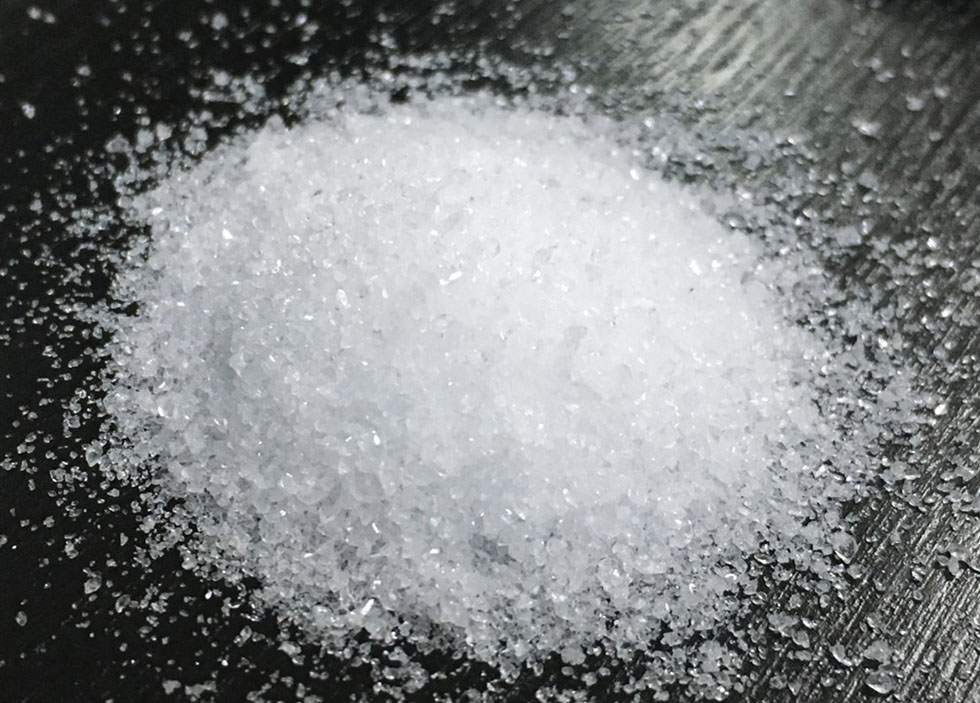
The product sheet lists 4 practical strengths: high reactivity with the carboxyl groups formed during hydrolysis, high purity with no residual raw-material monomer, good weathering resistance and broad polymer compatibility. A single small molecule is also the simplest starting point when you have no stabilizer in your formulation yet.
Two masterbatches carry a monomeric carbodiimide: HyMax® M10 on a PET carrier (light yellow pellets) and HyMax® MTPU20 on a polyester TPU carrier (white pellets). For companies that synthesize carbodiimides themselves, Langyi also supplies the intermediate 2,6-diisopropylphenyl isocyanate (CAS 28178-42-9).
Polymeric Carbodiimide: What It Is and Where It Fits
A polymeric carbodiimide carries several carbodiimide groups on one polymer chain. Langyi offers it in 2 physical forms: HyMax® 210 and HyMax® 213 as white to slightly yellow crystals, and HyMax® 220 as a slightly yellow liquid. Both solid grades are listed with good thermal stability and high activity.
HyMax® 210 and 213 share the same recommended polymers as HyMax® 1010, so they are the natural alternative when you want a polymeric structure in the same PET, PBT, TPU or PLA formulation. Their published properties are the same; ask for both data sheets if you need to compare them for a specific process.
HyMax® 220 is the liquid option. Langyi lists it for TPU, polyester polyols, CPU and PU adhesives, and highlights 2 properties: it is easy to add and mix, and it resists yellowing. Polymeric carbodiimide is also the active in HyMax® M20 (PET carrier, listed as high temperature resistant) and in HyMax® MPLA10 for PLA.
Side-by-Side Comparison of HyMax® 1010, 210, 213 and 220
The 4 base HyMax® grades split into 1 monomeric and 3 polymeric products. Three are crystals and one is a liquid, and all 4 are listed for polyester and polyurethane systems. The table below uses only the values published in Langyi's product sheets.
| Property | HyMax® 1010 | HyMax® 210 | HyMax® 213 | HyMax® 220 |
|---|---|---|---|---|
| Type | Monomeric | Polymeric | Polymeric | Polymeric |
| Appearance | White to slightly yellow crystals | White to slightly yellow crystals | White to slightly yellow crystals | Slightly yellow liquid |
| CAS number | 2162-74-5 | On TDS | On TDS | On TDS |
| Recommended systems | PET, PBT, TPU, CPU, PLA, PBAT, TPEE, PU adhesives | PET, PBT, TPU, CPU, PLA, PBAT, TPEE, PU adhesives | PET, PBT, TPU, CPU, PLA, PBAT, TPEE, PU adhesives | TPU, polyester polyols, CPU, PU adhesives |
| Key property listed | High reactivity, cost-effective | Good thermal stability, high activity | Good thermal stability, high activity | Liquid, resistant to yellowing |
Solid, Liquid or Masterbatch?
Form decides how the stabilizer enters your process. Langyi supplies HyMax® as crystals (1010, 210, 213), as a liquid (220) and as 6 masterbatches on PET, polyester TPU, PLA, PA6 and EVA carriers, so the same chemistry can be dosed as a powder, pumped into a polyol or fed as pellets at the extruder.
- Crystals suit compounders who already meter powders into a twin-screw extruder.
- Liquid suits polyurethane producers who blend additives into polyols or adhesive formulations.
- Masterbatch suits fiber, film and molding lines that prefer to add pellets with the base resin. Langyi notes that custom anti-hydrolysis masterbatches can be made to match production requirements.
| Masterbatch | Carrier | Active | Appearance | Typical use |
|---|---|---|---|---|
| HyMax® M10 | PET | Monomeric carbodiimide | Light yellow pellets | PET monofilament, film, fiber, recycled PET |
| HyMax® M20 | PET | Polymeric carbodiimide | Light yellow pellets | Same as M10 where high temperature resistance is needed |
| HyMax® MTPU20 | Polyester TPU | Monomeric carbodiimide | White pellets | TPU footwear, tubing, film, conveyor belts |
| HyMax® MPLA10 | For PLA | Polymer-grade carbodiimide | On TDS | PLA packaging, textiles, disposables |
| HyMax® M20A6 | PA6 | HyMax® stabilizer | Pale yellow pellets | PA6 compounds and molded parts |
| HyMax® EV521 | EVA | Carbodiimide-based | Pellets | Solar encapsulant film, EVA wire and cable |
How to Choose by Polymer
The polymer narrows the choice faster than any other factor. Langyi lists its solid grades for 8 polymer families, from PET and PBT to PBAT and TPEE, while each masterbatch is tied to one carrier resin. Use the table as a shortlist, then confirm with a trial on your own resin grade.
| Polymer | Solid or liquid grade | Masterbatch | Also consider |
|---|---|---|---|
| PET fiber, film, monofilament, recycled PET | HyMax® 1010, 210, 213 | M10, M20 | HyMax® M180 chain extender if melt strength or IV is also low |
| PBT electrical and automotive parts | HyMax® 1010, 210, 213 | Custom on request | — |
| Polyester TPU | HyMax® 1010, 210, 213, 220 | MTPU20 | — |
| PU adhesives, polyester polyols, cast PU | HyMax® 220; 1010, 210, 213 for PU adhesives | — | — |
| PLA and PBAT | HyMax® 1010, 210, 213 | MPLA10 (PLA) | HyMax® KL-180 for PLA/PBAT blends |
| PA6 | — | M20A6 | — |
| EVA encapsulant film | — | EV521 | Solar PV additive set |
Running a Trial
Langyi does not publish one loading for every polymer, because the right level depends on your resin grade and process. Its technical team recommends a starting level for each trial, based on 5 pieces of information you send with the inquiry.
- Polymer and grade, including whether TPU or PU is polyester or polyether type.
- Process and melt or cure temperature.
- Product form: fiber, film, molded part, foam or adhesive.
- Service conditions, such as hot water, damp heat or outdoor exposure.
- The test you need to pass and your current result, if any.
Frequently Asked Questions
What is the CAS number of HyMax® 1010?
HyMax® 1010 is bis(2,6-diisopropylphenyl)carbodiimide, CAS 2162-74-5, molecular formula C25H34N2.
Is there a liquid carbodiimide for polyester polyols?
Yes. HyMax® 220 is a slightly yellow liquid polymeric carbodiimide listed for polyester polyols, TPU, cast PU and PU adhesives. It is easy to mix and resists yellowing.
Can I add hydrolysis protection at the extruder without handling powder?
Yes. Langyi offers 6 anti-hydrolysis masterbatches on PET (M10, M20), polyester TPU (MTPU20), PLA (MPLA10), PA6 (M20A6) and EVA (EV521) carriers.
Does a carbodiimide raise the IV of recycled PET?
Carbodiimides slow hydrolysis. To rebuild molecular weight and melt strength, Langyi offers chain extenders: KL-180 epoxy powder and the M180 PET masterbatch.
Conclusion
Monomeric and polymeric carbodiimides protect polyesters and polyurethanes by the same reaction. Choose by process: HyMax® 1010 as the cost-effective, fast-reacting default, HyMax® 210 or 213 where thermal stability is the priority, HyMax® 220 for polyols and PU adhesives, and a masterbatch when you want to dose pellets at the extruder.
Request a Data Sheet or Sample
Tell us your polymer or resin system, your process and the property you need to improve. Our technical team replies with a grade recommendation, the technical data sheet and sample availability.
Related Guides
- Silver vs Zinc vs Copper Antimicrobial Additives
- Polycarbodiimide vs Blocked Isocyanate Crosslinkers
- Cesium Tungsten Oxide: Powder vs Dispersion vs Masterbatch
- How to Choose an Ion Scavenger for Epoxy Molding Compounds
- How to Choose a Carbodiimide Anti-Hydrolysis Agent Supplier in China
- How to Choose an Antimicrobial Additive Manufacturer in China
- Polymer Additive Manufacturer vs Trading Company in China
- Chain Extender Powder vs Masterbatch for Recycled PET and PLA
- Conductive vs Ionic Antistatic Agents for Plastics and TPU
- Acidic vs Alkaline Odor Absorbers for Plastics
- Zirconium Phosphate Flame Retardant Synergist
- How to Choose a Cesium Tungsten Oxide Supplier in China
- How to Choose an Inorganic Ion Scavenger Supplier
- All technical guides