
Acidic vs Alkaline Odor Absorbers for Plastics: How to Choose (2026)
An inorganic odor absorber is a powder added to a resin or plastic compound whose surface groups react with odor molecules and hold them, so the smell is removed rather than masked. Odors split into 2 chemical families, acidic and alkaline, and each needs a matching absorber. Langyi's AntistinkMax® range has one grade for each: BS2010 for acidic odors such as acetic and isovaleric acid, with a deodorizing capacity of 35 mL/g, and PJ2001 for ammonia and amines, with an ammonia capacity of 185 mL/g. This guide explains how to identify your odor, compares the 2 grades and covers particle size, combining grades and trial planning.
Data in this guide is taken from Langyi product sheets as of November 2026. Confirm values against the current technical data sheet before you fix a formulation.
Quick Answer: Which Odor Absorber Do You Need?
If the smell is sour, vinegar-like or sweaty, it is likely acidic: use AntistinkMax® BS2010. If it is sharp, fishy or ammonia-like, it is likely alkaline: use AntistinkMax® PJ2001. If both are present, the 2 grades can be combined in one formulation.
| AntistinkMax® BS2010 | AntistinkMax® PJ2001 | |
|---|---|---|
| Odor family | Acidic | Alkaline |
| Target odors | Acetic acid, isovaleric acid and similar | Ammonia, amines and similar |
| Deodorizing capacity | 35 mL/g | 185 mL/g (ammonia) |
| Appearance | White powder | White powder |
| Average particle size D50 | 3 ± 1 µm | 0.5 ± 0.1 µm |
| Mechanism | Chemical reaction; odor not released again | Chemical reaction; odor not released again |
How Chemical Odor Absorption Works
AntistinkMax® powders carry active groups on their surface that react with odor molecules. An acidic molecule such as acetic acid is neutralized by BS2010; an alkaline molecule such as ammonia is neutralized by PJ2001. Because the odor is bound by a chemical reaction, it is not released again when the part warms up.
This differs from fragrance masking, which covers a smell with another one, and from purely physical adsorption, where trapped molecules can desorb with heat. Both AntistinkMax® grades are inorganic, heat resistant and disperse evenly in resin systems, according to Langyi.
About Langyi and AntistinkMax®
Langyi is a Chinese developer and manufacturer of functional polymer additives, founded in Shanghai in August 2010, with R&D in Songjiang, Shanghai and production at its Yantai base in Shandong Province, in operation since 2020. AntistinkMax® is its odor control brand, part of a family of inorganic functional powders that also includes AntibacMax® antimicrobials and GrabMax® ion scavengers.
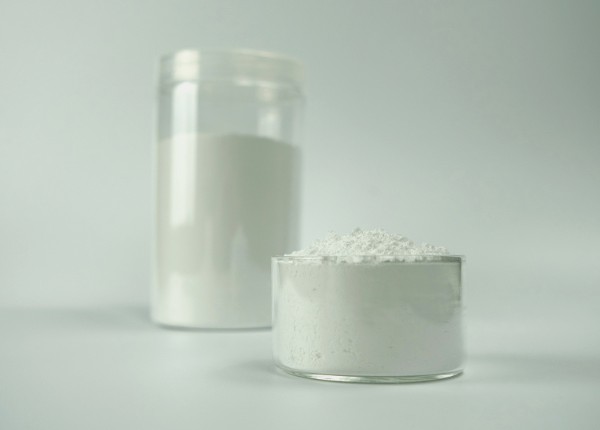
Both AntistinkMax® grades are white inorganic powders that bind odor by chemical reaction, one for each odor family. Compounders that already use AntibacMax® additives for surface hygiene can add odor control from the same supplier. Langyi reports 86 granted patents and R&D spending above 10% of revenue. Browse the odor absorber collection or read more about Langyi.
Identify Your Odor First
The most useful step before choosing a grade is naming the odor. Acidic odors include acetic acid, which can form when vinyl acetate-containing polymers such as EVA break down, and isovaleric acid, a typical component of sweat odor. Alkaline odors include ammonia and amines, which can come from amine-based catalysts, additives or degradation products.
A quick check is to describe the smell; a better one is headspace analysis of the compound or part, which names the volatile compounds. If the source is a residual monomer or a degrading additive, fixing that source may reduce the load the absorber has to handle.
Particle Size and Dispersion
PJ2001 is the finer grade, with a D50 of 0.5 ± 0.1 µm, while BS2010 has a D50 of 3 ± 1 µm. A finer powder offers more surface per gram and suits thin films and fibers better; a coarser powder is easy to handle in molded parts and thicker compounds.
Both grades are listed as dispersing evenly in resins and working at low loading. The loading you need depends on how much odor the part releases, its thickness and service temperature, so Langyi recommends a starting level for each trial.
Combining BS2010 and PJ2001
Many real odors are mixtures. Because each grade binds one chemical family, an acidic and an alkaline odor in the same part call for both. Add them to the same compound and test each odor separately, so you can tune each loading to its own target.
Planning a Trial
- Describe the odor, or send headspace results if you have them.
- Name the polymer and the process (molding, extrusion, film or fiber).
- Give the service temperature and the odor test your customer uses.
- Run a blank and 2–3 loadings, and assess odor after the same conditioning.
Frequently Asked Questions
Which AntistinkMax® grade removes ammonia?
PJ2001, which targets ammonia, amines and similar alkaline odors and has an ammonia capacity of 185 mL/g.
Which grade removes acetic acid odor?
BS2010, which targets acetic acid, isovaleric acid and similar acidic odors, with a deodorizing capacity of 35 mL/g.
Will the odor come back when the part gets warm?
Both grades bind odor molecules by chemical reaction, so the captured odor is not released again.
Can I use both grades together?
Yes. Each grade handles one odor family, so a part with both acidic and alkaline odors can use both.
Conclusion
Name the odor, then match the absorber: AntistinkMax® BS2010 for acidic odors such as acetic and isovaleric acid, PJ2001 for ammonia and amines, and both when the odor is mixed. Confirm the loading in a trial on your own part.
Request a Data Sheet or Sample
Tell us your polymer or resin system, your process and the property you need to improve. Our technical team replies with a grade recommendation, the technical data sheet and sample availability.
Related Guides
- Monomeric vs Polymeric Carbodiimide Hydrolysis Stabilizers
- Silver vs Zinc vs Copper Antimicrobial Additives
- Polycarbodiimide vs Blocked Isocyanate Crosslinkers
- Cesium Tungsten Oxide: Powder vs Dispersion vs Masterbatch
- How to Choose an Ion Scavenger for Epoxy Molding Compounds
- How to Choose a Carbodiimide Anti-Hydrolysis Agent Supplier in China
- How to Choose an Antimicrobial Additive Manufacturer in China
- Polymer Additive Manufacturer vs Trading Company in China
- Chain Extender Powder vs Masterbatch for Recycled PET and PLA
- Conductive vs Ionic Antistatic Agents for Plastics and TPU
- Zirconium Phosphate Flame Retardant Synergist
- How to Choose a Cesium Tungsten Oxide Supplier in China
- How to Choose an Inorganic Ion Scavenger Supplier
- All technical guides